


Gukesh vs Sindarov: Two Draws Set the Stage for an Intriguing World Championship Battle
Purvi Sehrawat
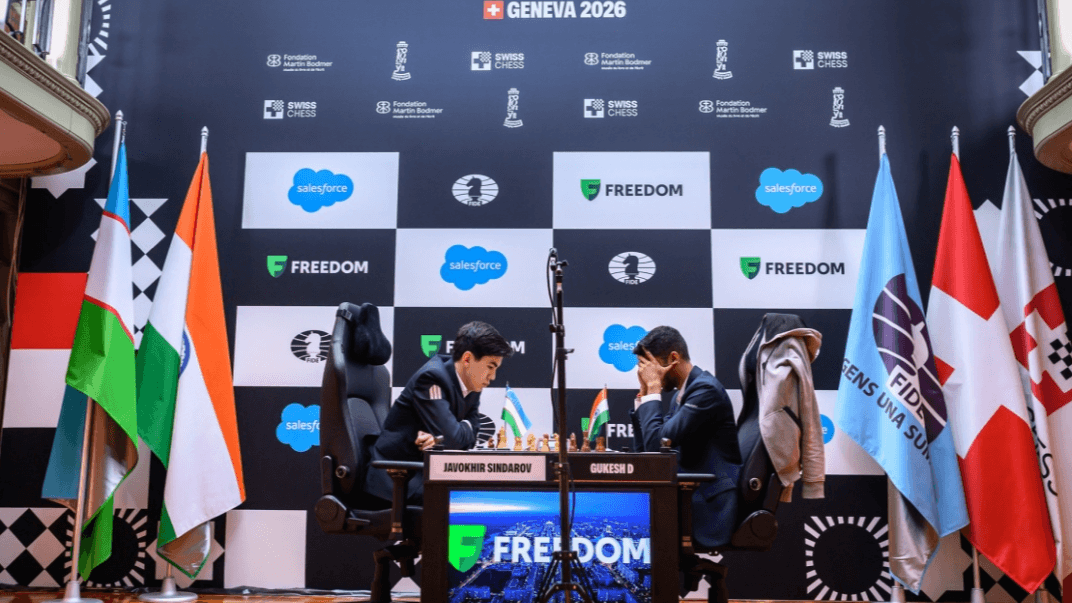
The 2026 Salesforce FIDE World Chess Championship has begun with two contrasting encounters between reigning World Champion GM D. Gukesh and challenger GM Javokhir Sindarov. After two games in Geneva, Switzerland, the match remains level at 1–1, with both grandmasters securing half a point in each encounter.

While the opening game developed into a lengthy 38-move strategic battle, the second encounter took a completely different direction, ending in just 20 moves. The contrasting approaches have already offered an interesting glimpse into the players' preparation, decision-making and willingness to take risks on the biggest stage in chess.
The championship is being played over a maximum of 14 classical games, with the first player to reach 7.5 points claiming the world title. With a prize fund of $2.5 million, the stakes are enormous for both contenders.
Game 1: Sindarov Tests Gukesh in a 38-Move Opening Encounter
The opening game, played on November 24, saw Sindarov take the White pieces against Gukesh. The Uzbek challenger opened with 1.e4, and Gukesh responded with 1. e5, leading to the Ruy Lopez.
Gukesh opted for the Berlin Defence, a variation known for its solid positional foundations and ability to neutralise White's early initiative. The queens were exchanged on move eight, taking the game into the familiar Berlin endgame.
Sindarov appeared well-prepared and played the opening quickly, looking to put his opponent under pressure. However, Gukesh's position remained resilient, and the Indian gradually worked towards neutralising White's activity.
One of the most interesting moments arrived around move 17. After Sindarov played 17.b3, Gukesh spent approximately 36 minutes considering his response before choosing 17. Bb4. The move targeted White's rook and formed part of a defensive plan that helped Black restrict White's possibilities.
The time difference became a major talking point. At one stage, Sindarov had more than 50 minutes on the clock than Gukesh. The Indian champion was eventually left with only a few minutes to complete the remaining moves before the first time control.
Despite the clock pressure, Gukesh demonstrated excellent defensive technique. His 27.Kf6 was particularly important, as it allowed him to maintain control of the position and avoid the attacking possibilities Sindarov had been hoping to create.
The challenger later acknowledged that he had underestimated the safety of Gukesh's king on f6.
As the game approached its conclusion, Sindarov attempted to force a repetition. An interesting incident occurred when he incorrectly claimed a draw by repetition, prompting the arbiter to award Gukesh an additional two minutes. The players subsequently repeated the position correctly and agreed to a draw.
After 38 moves and nearly four hours of play, the first encounter ended peacefully.
Game 1 details:
White: Javokhir Sindarov
Black: D. Gukesh
Opening: Ruy Lopez, Berlin Defence
Result: ½–½
Total moves: 38
Notable clock moment: Gukesh spent approximately 36 minutes on 17...Bb4.
Both players produced a highly accurate performance, with no decisive errors according to the published engine analysis. The game demonstrated Gukesh's ability to defend under pressure and Sindarov's willingness to keep searching for winning chances.
Game 2: Gukesh and Sindarov Agree to a 20-Move Draw
The second game, played on November 25, brought a change of colours, with Gukesh taking White for the first time in the match.
After being tested in the opening encounter, the defending champion had an opportunity to take the initiative. He opened with 1.d4 and opted for the London System, a strategically solid opening that can offer White a comfortable position without immediately creating significant weaknesses.
Sindarov responded confidently and demonstrated that he had prepared for Gukesh's choice. One of the interesting features of the opening was his early queen manoeuvre to b6, putting pressure on White's queenside.
The players exchanged knights on e5, and Black managed to neutralise White's early ambitions. Sindarov's position remained comfortable as he continued to find practical responses to Gukesh's plans.
However, the most noticeable aspect of the game was Gukesh's time consumption.
The Indian grandmaster invested approximately 14 minutes before castling on move 12. He then spent nearly 30 minutes considering his 16th move, a considerable amount of time in a game that was still developing along relatively balanced positional lines.
Sindarov, meanwhile, maintained a clock advantage and appeared comfortable with the position. His defensive setup prevented Gukesh from generating meaningful attacking opportunities.
Unlike the first game, where both players continued fighting through a complicated middlegame, the second encounter gradually moved towards a balanced position.
After just 20 moves, the players agreed to a draw.
The result brought the match score to 1–1, with both grandmasters continuing their search for the first decisive victory.
Game 2 details:
White: D. Gukesh
Black: Javokhir Sindarov
Opening: London System
Result: ½–½
Total moves: 20
Notable clock moments: Gukesh spent approximately 14 minutes before castling on move 12 and nearly 30 minutes on move 16.
The quick conclusion was particularly unusual for a World Championship encounter involving Gukesh, who is generally known for his fighting approach and willingness to explore complicated positions.
Time Management and Accuracy: Two Different Games
The opening two encounters have highlighted an interesting contrast in the players' approaches to classical chess.
In Game 1, Sindarov managed to maintain a substantial clock advantage, while Gukesh invested considerable time in finding defensive resources. His 36-minute think on move 17 became one of the defining moments of the encounter.
In Game 2, the situation was different. Gukesh spent significant time on his decisions despite having the White pieces, while Sindarov appeared comfortable with his preparation and managed to equalise without allowing a serious attack.
Both games ended in draws, but their character was very different. The first was a prolonged strategic battle involving king safety, pawn structures and clock pressure. The second was a much shorter positional encounter in which neither player managed to establish a meaningful advantage.
Regarding accuracy percentages, exact Chess.com accuracy scores for both games have not been independently verified in the available reports. FIDE described the first game as highly accurate, and published engine analysis found no decisive errors. It would be misleading to assign numerical accuracy percentages without the corresponding game-analysis data.
Chessveda Brings the World Championship Action to Chess Fans
With the world's attention on Geneva, chess fans can also follow the championship through Chessveda's live streaming coverage.
Chessveda is streaming the 2026 FIDE World Chess Championship, bringing the excitement of the Gukesh-Sindarov contest closer to chess enthusiasts.
From opening preparation and positional battles to critical decisions under time pressure, the World Championship provides an opportunity for players of every level to follow and learn from elite chess.
Watch the live coverage of the FIDE World Chess Championship 2026 on Chessveda:
LiveStream - Gukesh vs Sindarov
What Lies Ahead?
With the first two games ending in draws, the championship remains wide open. Gukesh and Sindarov have both demonstrated strong preparation, but neither has managed to convert their opportunities into a full point.
The upcoming encounters will be particularly interesting as both players look to introduce new ideas and create more challenging positions.
Sindarov has already shown that he is comfortable competing against the reigning champion, while Gukesh has demonstrated his ability to remain composed even when facing difficult clock situations.
Two games have produced two different stories, but the bigger battle for the world title is only beginning. Chess fans can expect more intense strategic contests as the championship continues in Geneva.
Comments(0)