


How to Join an Online Chess Tournament: A Beginner's Guide
Playing your first online chess tournament is easier than you think. This beginner's guide walks you through how online tournaments work, how to register step by step, what entry fees and prizes really mean, and the tips that make your first tournament fun instead of stressful — featuring Chessveda's Dussehra Chess Championship 2026 as a real example.
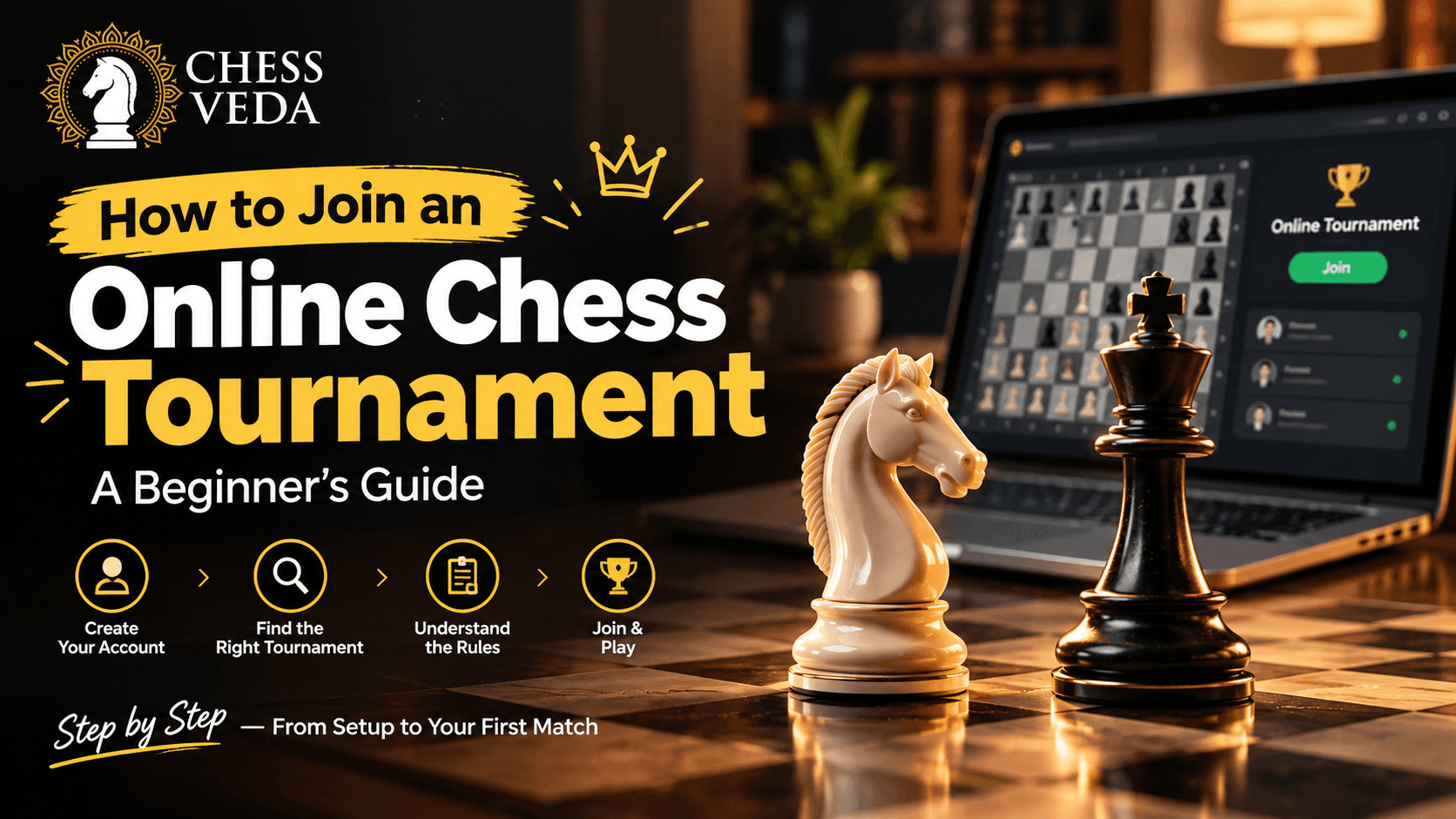
You've been playing casual games for a while now. You win some, you lose some, and somewhere along the way a thought creeps in: what would it feel like to play a real tournament — with rounds, standings, and something on the line? If you're wondering how to join an online chess tournament, the good news is that it's far simpler than most beginners expect. No travel, no entry queues, no intimidating hall full of silent grandmasters. You register from your couch, play from your laptop, and the whole thing usually wraps up in a single evening.
This guide walks you through everything: how online tournaments work, how to register step by step, what entry fees and prizes actually look like, and what your first tournament day will feel like. If you want to see what's coming up, the chess tournament online page on Chessveda lists live and upcoming events you can join right now.
How online chess tournaments actually work
Forget everything you imagine from movies. An online chess tournament is just a structured set of games played over the internet, usually in one sitting. Here's the basic anatomy:
Rounds. Instead of one game, you play several — typically 5 to 9 rounds. After each round, you're paired with someone on a similar score, so the games stay competitive even if you lose your first two. This is called the Swiss system, and it's the reason a beginner can have fun in the same event as a 2000-rated player.
Time controls. Tournament games are timed. A common format is rapid — say 10 minutes per side, sometimes with a few seconds added per move. The clock is the great equalizer: everyone plays under the same pressure, and flagging (losing on time) is a completely legitimate way to win.
Standings and tiebreaks. You earn a point for a win, half a point for a draw. At the end, the player with the most points wins. If two players tie, tiebreak scores sort it out — you don't need to understand the math, the platform handles it.
Sections. Bigger events split players by rating — an open section for everyone, plus under-1200, under-1600, and similar brackets. As a beginner, always enter the section closest to your level. Playing people near your strength is more fun and more instructive than getting crushed by experts.
The whole thing runs on the platform itself. Pairings appear automatically, your board loads when the round starts, and results update live. You just show up on time and play.
How to join an online chess tournament: step by step
Let's make this concrete. Here's the exact sequence, using a real example: Chessveda's Dussehra Chess Championship 2026, scheduled for 20th October 2026, with a ₹40,000 total prize pool, top-10 prizes (1st ₹5,000, 2nd ₹3,500, 3rd ₹2,500), and a ₹200 registration fee.
Step 1 — Create your account and sign in. On Chessveda, signing in is required to play and to enter tournaments. This matters because your games, rating, and tournament history are tied to your account — the platform needs to know who you are to pair you and award prizes.
Step 2 — Find the tournament. Head to the tournaments page and look for the event banner or listing. The Dussehra Championship, for instance, is advertised right on the homepage with its date, prize pool, and a "Register Now" button. Check three things before you commit: the date and start time (note the timezone), the time control, and whether there's a rating section that fits you.
Step 3 — Read the rules. Every tournament has a short rules list: how many rounds, the time control, what happens if you disconnect, and the fair-play policy. Read it. The fair-play part is serious — engine assistance gets accounts banned, and tournament games are monitored more closely than casual ones.
Step 4 — Pay the entry fee if there is one. The Dussehra Championship charges ₹200 to enter. That fee goes toward the prize pool and keeps the field serious — free events tend to fill up with no-shows. You'll pay through the platform's normal payment flow, and your seat is confirmed instantly.
Step 5 — Show up early on tournament day. Log in 15–20 minutes before the start. Check that your board loads, your clock is visible, and your internet is stable. Most platforms open a pre-tournament lobby where you can see the player list and confirm you're registered.
Step 6 — Play every round. Rounds start automatically at scheduled times. Win or lose, keep playing — your final standing, and honestly your enjoyment, depends on finishing all rounds. Withdrawing halfway helps nobody, least of all you.
That's the whole process. From "I've never played a tournament" to "I'm registered" takes about ten minutes.
Entry fees and prizes, explained
Beginners often have two opposite misconceptions about tournament money: either that all tournaments cost a fortune, or that prizes are a scam. The reality is refreshingly ordinary.
Why entry fees exist. A fee like the Dussehra Championship's ₹200 does three things: it funds the prize pool, it filters out people who register and never show up, and it pays for the platform running the event. Small local online events often charge ₹100–₹500; bigger ones more. Many beginner-friendly events are completely free.
How prizes work. The prize pool is split among the top finishers — usually the top 3 to top 10, sometimes with extra prizes for the best woman player, best junior, or best in a rating section. In the Dussehra Championship, the top 10 all win something, with ₹5,000 for first place out of a ₹40,000 pool. Prizes are typically credited to your account or paid out through the platform's standard withdrawal process after results are finalized.
What to realistically expect. Here's the honest part: in your first few tournaments, you are not playing for the money. You're playing for the experience — the pressure, the clock, the stronger opposition. Treat the entry fee as the price of a good evening's chess, not an investment. If you win something, that's a bonus. Players who enter tournaments expecting to profit usually leave disappointed; players who enter to learn usually leave better.
What to expect on tournament day
Knowing the rhythm of the day takes most of the anxiety out of it. A typical rapid tournament evening looks like this:
Before round 1, there's a short waiting period. You'll see the player list, maybe a countdown timer. Use this time to settle in — close other tabs, silence your phone, get water.
Each round follows the same beat: pairings are announced, your board loads, the clock starts. You play one game. When it ends — win, lose, or draw — there's a break of a few minutes before the next round's pairings go up.
Between rounds, don't over analyze. Glance at the standings if you like, stretch, breathe. Reviewing your last game in depth between rounds usually just tilts you for the next one. Save the analysis for tomorrow.
The clock is the biggest adjustment. In casual games you might let your time drift; in a tournament, every second matters and your opponent's clock is part of your strategy. If you're winning on the board but low on time, simplify. If you're losing on the board but up on time, complicate. This is a skill, and your first tournament is where you start learning it.
Nerves are normal. Your heart will pound in round 1. Everyone's does — even experienced players feel it. It fades by round 3, and by the final round you'll wonder what you were worried about

Tips for your first tournament
A few practical things that separate a smooth first tournament from a chaotic one:
Play the right time control for you. If you've only ever played blitz, a 10-minute rapid event will feel luxurious — in a good way. Don't enter a blitz tournament as your first event; the chaos will teach you nothing except how fast you can blunder.
Use a real setup. Laptop or desktop, not your phone. A mouse, not a touchscreen. Tournaments are decided by mouse slips more often than anyone admits, and a proper setup removes an entire category of silly losses.
Check your internet. This sounds obvious until your router drops in round 4 of a tournament you paid to enter. Wired connection if you can, and keep a phone hotspot ready as backup.
Arrive with a plan for your openings. You don't need deep preparation — just know what you'll play as White and Black for the first 5–6 moves. Tournament games punish "I'll figure it out over the board" thinking much harder than casual games do.
Eat before, not during. Tournament evenings run 2–4 hours. A proper meal beforehand beats snacking between rounds, when your hands are shaky and the clock is ticking.
Keep scores simple. Your only job in round 1 is to play decent chess and finish the game. Don't track your projected prize, don't calculate tiebreaks, don't watch the top boards. Play your game.
Mistakes beginners make (and how to dodge them)
Registering for the wrong section. Entering the open section "for the challenge" when there's an under-1200 bracket is not brave, it's just less fun. Play your level.
Skipping the rules. Every tournament's rules have one quirk — a weird tiebreak, a strict no-show policy, a specific fair-play check. The five minutes it takes to read them saves real frustration later.
Playing too fast because of nerves. Adrenaline makes everyone play faster. Consciously slow down in the first few moves of each game — most first-tournament blunders happen before move 10.
Quitting after two losses. The Swiss system is designed so that after early losses, you get paired with players at your level. Rounds 4–6 of your first tournament are often the most enjoyable games you'll play all month. Don't rob yourself of them.
Blaming the platform. Lag happens, mouse slips happen. But nine times out of ten, the game was lost at the board, not in the browser. Review honestly and you'll improve; complain and you won't.
Frequently asked questions
Do I need a rating to join an online chess tournament?
No. Most online tournaments are open to unrated players — you'll usually be placed in the lowest section or given a provisional rating after your first few games. Your Chessveda rating from casual games often carries over automatically.
How much does it cost to enter?
It varies. Many beginner events are free. Paid events on Chessveda typically range from ₹100 to ₹500 — the Dussehra Chess Championship 2026, for example, charges ₹200 with a ₹40,000 prize pool. Always check the tournament listing for the exact fee before registering.
How long does a tournament take?
A typical rapid tournament with 5–7 rounds takes 2–4 hours including breaks. Blitz events are shorter; classical-style online events can stretch across multiple days. The listing always shows the schedule — don't register for something you can't finish.
Can I win real money as a beginner?
It's possible but unlikely in your first events — stronger, experienced players usually take the top prizes. Enter your first tournaments for the experience and treat any prize as a bonus, not the goal.
What happens if my internet disconnects mid-game?
Most platforms give you a short reconnection window, and your clock keeps running while you're gone. If you can't reconnect, the game is usually scored as a loss. This is why a stable connection and a backup hotspot matter.
Is it okay to withdraw if I'm doing badly?
You can, but you shouldn't make a habit of it. Finishing all rounds is part of tournament etiquette — your opponents deserve a game, and the pairings depend on everyone showing up. Bad tournaments are where the learning happens anyway.
Joining your first tournament is one of those small steps that changes how you relate to chess. Casual games are fun, but a tournament — with its rounds, its clock, its little knot of nerves in round 1 — teaches you things about your game that no amount of casual play can. The Dussehra Chess Championship on 20th October 2026 is a genuinely good first event: a real prize pool, a serious but welcoming field, and a single-evening format. Check the chess tournament online listings, pick your event, and register. Your future self — the one with tournament experience — will thank you.
By Chessveda
More from Blogs

How to Play Chess With Friends Who Live in Different Cities
Your chess friends moved to other cities? Here is how to keep playing together online — challenge links, slow games, and a weekly rivalry that lasts.
Online Chess vs Over-the-Board Chess: What Actually Changes
Online chess or a real board — what truly changes between the two? The clock, the records, the etiquette and your focus, compared honestly.
How Long Does It Take to Learn Chess? An Honest Answer
How long does it take to learn chess? The rules take an afternoon. Playing well takes longer. Here is an honest stage-by-stage timeline for beginners.
Comments(0)